When words fail, art speaks. Here is what the research says about why creative expression is one of the most effective tools for trauma recovery — and how USMI puts it into practice.
Trauma leaves marks that words alone cannot reach. For millions of survivors — veterans, youth in foster care, individuals who have experienced abuse or loss — traditional talk therapy is only part of the answer. Art therapy offers something different: a pathway to healing that bypasses language entirely, working directly through the body, the hands, and the creative act itself.
The evidence is growing. Research in neuroscience and psychology increasingly supports what art therapists have known for decades: creating art activates parts of the brain that are suppressed or dysregulated by trauma, opening doors to processing and recovery that verbal therapy cannot always access alone.
At USMI, we have seen this transformation firsthand — in every brushstroke, every song written, every movement performed by the 428+ creatives and families we have supported across five continents.
What Happens in the Traumatized Brain
To understand why art therapy works, it helps to understand what trauma does to the brain. When a person experiences a traumatic event, the brain’s stress response system — centered in the amygdala — goes into overdrive. The prefrontal cortex, responsible for language and rational thought, becomes less active.
This is why trauma survivors often struggle to “talk about” their experiences. The part of the brain that processes language is, quite literally, less available. The trauma is stored not in narrative memory, but in the body — in physical sensations, emotional responses, and fragmented images.
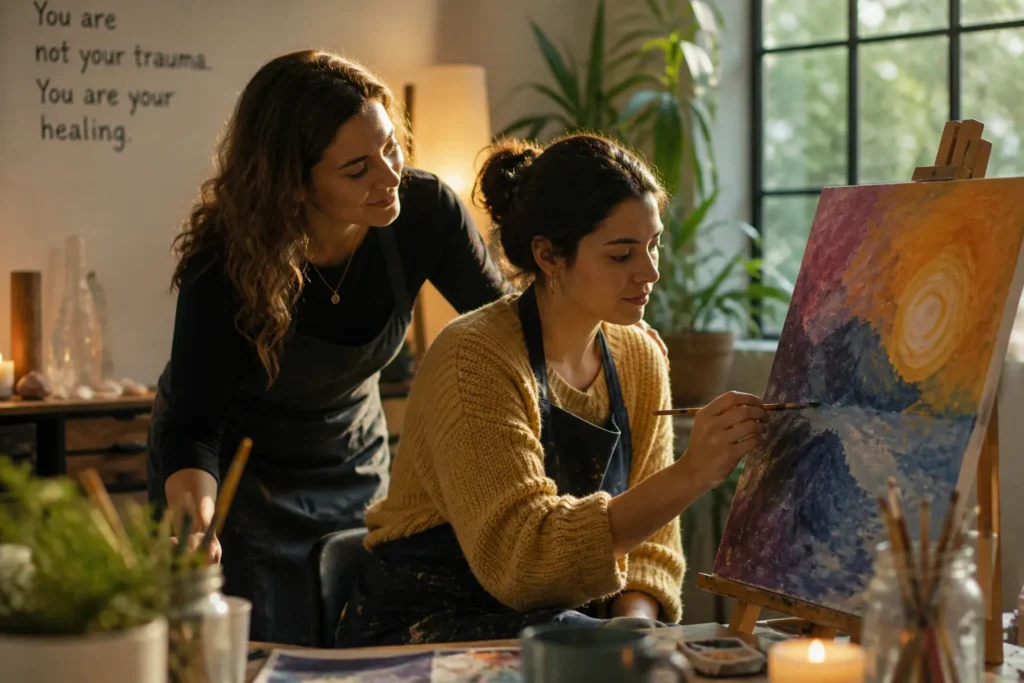
Art therapy works with this reality rather than against it. By engaging the hands, the eyes, and the body in creative expression, art therapy activates sensory and emotional processing pathways that are separate from verbal language. The act of painting a feeling, composing a song about a memory, or moving through grief in a dance can reach places that words cannot.
The Science: What the Research Shows
Studies have consistently found that art therapy reduces symptoms of post-traumatic stress disorder (PTSD), anxiety, and depression among trauma survivors. Research published in peer-reviewed journals has documented measurable changes in cortisol levels — the body’s primary stress hormone — following art therapy interventions.
Neuroimaging studies have shown that creative activities engage the brain’s reward system, triggering the release of dopamine and promoting feelings of calm and safety. For individuals whose nervous systems are chronically on high alert due to trauma, this physiological shift is not just comforting — it is therapeutic.
Music therapy, a core component of USMI’s programs, has been shown to activate regions of the brain associated with memory and emotion simultaneously, allowing survivors to revisit and reprocess difficult experiences in a contained, safe environment.
How USMI Puts It Into Practice
USMI’s art therapy programs are built on a trauma-informed foundation. Every program is facilitated by certified therapeutic professionals trained to create environments of safety, trust, and creative freedom. Sessions are available in one-on-one and group formats, and are adapted to the specific needs of each population we serve.
“After losing her parents, Ada struggled with unbearable grief and isolation. When she joined the music therapy program, she found her voice again — both literally and figuratively. Writing songs became her way of processing her pain.”— Ada, Music Therapy Participant
For veterans like David, the journey looked different. After years of conflict, painting became the language he needed. His artwork transformed from dark, chaotic strokes to vibrant, hopeful images — a visual record of his healing. Today, David mentors others in the program.
These are not isolated stories. They are what happens when people are given the right tools, the right environment, and the right support.
Who Benefits from Art Therapy
Art therapy is effective across a wide range of populations and trauma types. USMI’s programs serve veterans dealing with combat-related PTSD, youth in foster care who have experienced neglect or abuse, survivors of domestic violence, individuals navigating grief and loss, and adults managing anxiety, depression, or complex trauma histories.
The approach is not one-size-fits-all. At USMI, every program is tailored to the specific context and needs of its participants — whether that means a structured music composition workshop, a free-form painting session, or a movement-based group experience.
Art Therapy Is Not Art Class
It is important to distinguish art therapy from art education. In art therapy, the product — the painting, the song, the poem — is secondary to the process. No artistic skill is required. The goal is not technical excellence; it is emotional expression, self-discovery, and healing.
Participants do not need to be artists. They need only be willing to show up and let the creative process do its work. At USMI, we have seen that willingness rewarded — in measurable, lasting ways — again and again.
Our art therapy programs are free for participants. Support our mission.Donate to USMI
The Path Forward
Trauma is not a life sentence. With the right support, the human capacity for healing is extraordinary. Art therapy is not a replacement for other forms of treatment — it is a complement, a bridge, a door that opens where others have closed.
At USMI, we believe that creative expression is not a luxury. It is a necessity. And for the communities we serve, access to that expression — and to the healing it makes possible — is a matter of justice.
If you or someone you know could benefit from our programs, we invite you to reach out. If you are in a position to support this work, we invite you to give. The science is clear. The stories are real. The transformation is possible.